

LangGraph 是一个用于构建有状态 LLM 应用的框架,因此非常适合构建 ReAct(推理和行动)智能体。
ReAct 智能体将 LLM 推理与行动执行相结合。它们会迭代思考、使用工具并根据观察结果采取行动,以实现用户目标,并动态调整其方法。这种模式在“ReAct:在语言模型中协同推理和行动” (2023) 中首次提出,旨在模仿人类般的灵活问题解决方式,而不是僵化的工作流。
LangGraph 提供了一个预构建的 ReAct 智能体 (
create_react_agent),
当您需要对 ReAct 实现进行更多控制和自定义时,它会大放异彩。本指南将向您展示一个简化版本。
LangGraph 使用三个关键组件将智能体建模为图:
State:共享数据结构(通常为TypedDict或Pydantic BaseModel),表示应用的当前快照。Nodes:对智能体的逻辑进行编码。它们接收当前状态作为输入,执行一些计算或副作用,并返回更新后的状态,例如 LLM 调用或工具调用。Edges:根据当前State定义要执行的下一个Node,从而实现条件逻辑和固定转换。
如果您还没有 API 密钥,可以从 Google AI Studio 获取一个。
pip install langgraph langchain-google-genai geopy requests
在环境变量 GEMINI_API_KEY 中设置您的 API 密钥。
import os

# Read your API key from the environment variable or set it manually
api_key = os.getenv("GEMINI_API_KEY")
为了更好地了解如何使用 LangGraph 实现 ReAct 智能体,本指南将介绍一个实际示例。您将创建一个智能体,其目标是使用工具查找指定位置的当前天气。
对于此天气智能体,State 将维护正在进行的对话历史记录(作为消息列表)和一个计数器(作为整数),用于说明已采取的步骤数。
LangGraph 提供了一个辅助函数 add_messages,用于更新状态消息列表。它充当 reducer,
接收当前列表以及新消息,并返回合并后的列表。它通过消息 ID 处理更新,并默认为新消息和未见消息采用“仅追加”行为。
from typing import Annotated,Sequence, TypedDict

from langchain_core.messages import BaseMessage
from langgraph.graph.message import add_messages  # helper function to add messages to the state

class AgentState(TypedDict):
    """The state of the agent."""
    messages: Annotated[Sequence[BaseMessage], add_messages]
    number_of_steps: int
接下来,定义您的天气工具。
from langchain_core.tools import tool
from geopy.geocoders import Nominatim
from pydantic import BaseModel, Field
import requests

geolocator = Nominatim(user_agent="weather-app")

class SearchInput(BaseModel):
    location:str = Field(description="The city and state, e.g., San Francisco")
    date:str = Field(description="the forecasting date for when to get the weather format (yyyy-mm-dd)")

@tool("get_weather_forecast", args_schema=SearchInput, return_direct=True)
def get_weather_forecast(location: str, date: str):
    """Retrieves the weather using Open-Meteo API.

    Takes a given location (city) and a date (yyyy-mm-dd).

    Returns:
        A dict with the time and temperature for each hour.
    """
    # Note that Colab may experience rate limiting on this service. If this
    # happens, use a machine to which you have exclusive access.
    location = geolocator.geocode(location)
    if location:
        try:
            response = requests.get(f"https://api.open-meteo.com/v1/forecast?latitude={location.latitude}&longitude={location.longitude}&hourly=temperature_2m&start_date={date}&end_date={date}")
            data = response.json()
            return dict(zip(data["hourly"]["time"], data["hourly"]["temperature_2m"]))
        except Exception as e:
            return {"error": str(e)}
    else:
        return {"error": "Location not found"}

tools = [get_weather_forecast]
现在,初始化模型并将工具绑定到模型。
from datetime import datetime
from langchain_google_genai import ChatGoogleGenerativeAI

# Create LLM class
llm = ChatGoogleGenerativeAI(
    model= "gemini-3.5-flash",
    temperature=1.0,
    max_retries=2,
    google_api_key=api_key,
)

# Bind tools to the model
model = llm.bind_tools([get_weather_forecast])

# Test the model with tools
res=model.invoke(f"What is the weather in Berlin on {datetime.today()}?")

print(res)
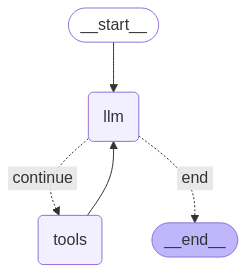
在运行智能体之前,最后一步是定义节点和边缘。在此示例中,您有两个节点和一个边缘。
- 执行工具方法的
call_tool节点。LangGraph 为此提供了一个名为 ToolNode的预构建节点 。 - 使用
model_with_tools调用模型的call_model节点。 - 决定是调用工具还是模型的
should_continue边缘。
节点和边缘的数量不是固定的。您可以根据需要在图中添加任意数量的节点和边缘。例如,您可以添加一个用于添加结构化输出的节点,或者添加一个自我验证/反思节点,以便在调用工具或模型之前检查模型输出。
from langchain_core.messages import ToolMessage
from langchain_core.runnables import RunnableConfig

tools_by_name = {tool.name: tool for tool in tools}

# Define our tool node
def call_tool(state: AgentState):
    outputs = []
    # Iterate over the tool calls in the last message
    for tool_call in state["messages"][-1].tool_calls:
        # Get the tool by name
        tool_result = tools_by_name[tool_call["name"]].invoke(tool_call["args"])
        outputs.append(
            ToolMessage(
                content=tool_result,
                name=tool_call["name"],
                tool_call_id=tool_call["id"],
            )
        )
    return {"messages": outputs}

def call_model(
    state: AgentState,
    config: RunnableConfig,
):
    # Invoke the model with the system prompt and the messages
    response = model.invoke(state["messages"], config)
    # This returns a list, which combines with the existing messages state
    # using the add_messages reducer.
    return {"messages": [response]}

# Define the conditional edge that determines whether to continue or not
def should_continue(state: AgentState):
    messages = state["messages"]
    # If the last message is not a tool call, then finish
    if not messages[-1].tool_calls:
        return "end"
    # default to continue
    return "continue"
准备好所有智能体组件后,您现在可以组装它们了。
from langgraph.graph import StateGraph, END

# Define a new graph with our state
workflow = StateGraph(AgentState)

# 1. Add the nodes
workflow.add_node("llm", call_model)
workflow.add_node("tools",  call_tool)
# 2. Set the entrypoint as `agent`, this is the first node called
workflow.set_entry_point("llm")
# 3. Add a conditional edge after the `llm` node is called.
workflow.add_conditional_edges(
    # Edge is used after the `llm` node is called.
    "llm",
    # The function that will determine which node is called next.
    should_continue,
    # Mapping for where to go next, keys are strings from the function return,
    # and the values are other nodes.
    # END is a special node marking that the graph is finish.
    {
        # If `tools`, then we call the tool node.
        "continue": "tools",
        # Otherwise we finish.
        "end": END,
    },
)
# 4. Add a normal edge after `tools` is called, `llm` node is called next.
workflow.add_edge("tools", "llm")

# Now we can compile and visualize our graph
graph = workflow.compile()
您可以使用 draw_mermaid_png 方法可视化图。
from IPython.display import Image, display

display(Image(graph.get_graph().draw_mermaid_png()))
现在运行智能体。
from datetime import datetime
# Create our initial message dictionary
inputs = {"messages": [("user", f"What is the weather in Berlin on {datetime.today()}?")]}

# call our graph with streaming to see the steps
for state in graph.stream(inputs, stream_mode="values"):
    last_message = state["messages"][-1]
    last_message.pretty_print()
您现在可以继续对话,询问另一个城市的天气,或请求比较。
state["messages"].append(("user", "Would it be warmer in Munich?"))

for state in graph.stream(state, stream_mode="values"):
    last_message = state["messages"][-1]
    last_message.pretty_print()